Yes, I know that for a large portion of us older gamers, this word is considered obscene.
But hear me out for just one moment. Listen to my plea.
There had to be some reason that so many of us committed hours upon hours of our youth to this game.
And I think I know why.
All in all, Runescape is a wonderful introduction to the realm of MMOs. It's like a gateway drug: cheap, easy to learn, and all-consuming. The desire to make more money, buy better gear, and level up skills can devour hours of time on weekends. Its simplistic, non-linear nature is easy to follow, and there are enough possible things to occupy oneself with at any point in time that it rarely gets excessively boring for those with a desire to advance in rank.
Starting off as a level one in almost every skill, one can decide what exactly they're going to pursue. Want to start any production skill? All you have to do is make some cash and buy the item that correlates to that skill. Nodes to acquire resources are spread throughout the world and are relatively easy to access, and as long as the server isn't too populated, there's little contest to gain maximum output.
If production isn't your thing, you can begin in any of the three disturbingly simple combat trees. Simply find or acquire a weapon (a sword, bow + arrows, or some basic runes), and you can begin fighting monsters and leveling up.
The lack of complexity makes this game incredibly attractive to young gamers who have little to no exposure to the procedures of an MMO. And leveling up is fun! Rewards are tangible or noticable, and progress always results from time commitment. The amount of profit directly correlates to the amount of time put in - no skill is required to click on a tree to chop it down.
As many of us grow older, however, we come to realize how tedious this game truly can be. Sure, you can put in tons of time to cut down half a million trees and reach level 60 woodcutting...but after that many point-and-click repetitions, things become unentertaining. We realize that the acquisition of resources - whether they're wood, minerals, or cooking items - takes so long that it isn't near worth the commitment. Combat becomes a repetetive point-and-click drawl as well, with little variation besides 'oh no, I'm low on health, let me click on this food'. The repertoie of available quests is dull, and they lack variation: "Run around the world for X hours, doing pointless tasks, and you can prevent yourself from spending 10 gold every time you want to cross through this gate," or something similar. After the novelty of material progress wears off, the lack of depth and intriguing new content drives many players away.
Becoming a member lengthens entertainment for a short amount of time: sure, there are more places to travel to, and more skills to advance, but they're essentially all the same thing: point-and-click for X hours until you reach the next level.
While RuneScape was fun for a couple of years, I haven't returned to it since...it's grown old, and needs to grow up or accept its demise.
Have fun, good gaming, and remember:
don't feed the trolls.
-Toast
Thursday, February 2, 2012

Sunday, January 15, 2012
League of Legends: Details 03
Now, I'll cover the basic purpose of Abilities in League of Legends.
There are three ends that an ability can serve:
To deal damage to enemies;
to disable enemies;
and to assist allies.
There are quite a number of ways that all of these ends can be accomplished in each category, and many abilities fall in to more than one, if not all three, categories. I'll begin my dissemination by detailing damage-dealing abilities.
Damage can be dealt in one of two basic ways. Either champions can poke their enemies down slowly but steadily, employing a disable to prevent their escape and finish the kill; or champion nukes can drop every heavy-hitting ability they have at once for a devastating health drop, hoping that it will finish their enemies off in one blow. These two different characteristics correspond to the statistics discussed previously: Attack Damage, Attack Speed, and Ability Power. Nukes and pokers can use either of these statistics to their advantage. Determining which to use is merely a matter of finding out which develops (or 'ramps') your damage output capabilities more effectively. After discovering this, one simply must find what item effects benefit that character's ability set, and they're ready to play well.
Abilities that disable enemies come in quite a few different varieties. Skill shots depend on the aiming capabilities of the player: they fly along a straight path the player chooses. Area of effect disables are much easier to land, but are generally less potent than skill shots. Disables come in quite a good variety themselves. Stuns and slows are the most common, but characters can also knock enemies into the air, bash them into walls, and simply trap them with impassable land. All of these abilities can be used in any fight to drastically reduce the viability of an enemy character, and generally they are focused upon squishy, easy to kill characters to prevent them from dealing damage and remaining present for any extended encounter.
Assist spells are much less prominent. Characters that have assists can boost their allies' movement speeds, heal them, shield them with extra health or protect them from spells, or buff any of their offensive or defensive characteristics. Though these may seem crucial, they are much less prevalent in champion selections, as they tend to lack the potency required during an extended encounter.
Any of these abilities can be thrown together to make a champion whose abilities are different than another's. However, there are some champions who have abilities unique to themselves that allow them to teleport, summon non-player allies, and even duplicate themselves. These unique abilities tend to be devastating when used correctly. Take Kassadin for example. His Riftwalk ultimate allows him to teleport within a short range of himself, dealing damage and setting up subsequent teleports. This allows him to pursue enemies more effectively than most champions, and can deal substantial damage on its own. Lux or Ezreal's ultimate allows them to shoot a powerful, long-range beam down any direction, hitting any enemies it encounters and dealing massive damage. And the grand Tryndamere ultimate allows him to survive after his health falls to zero and continue battling; this often allows him time to escape and heal with his other abilities.
I've scratched the surface of abilities in this blog...next time around, I'll cover map control and team fight dynamics.
Have fun, good gaming, and remember:
don't feed the trolls.
-Toast
There are three ends that an ability can serve:
To deal damage to enemies;
to disable enemies;
and to assist allies.
There are quite a number of ways that all of these ends can be accomplished in each category, and many abilities fall in to more than one, if not all three, categories. I'll begin my dissemination by detailing damage-dealing abilities.
Damage can be dealt in one of two basic ways. Either champions can poke their enemies down slowly but steadily, employing a disable to prevent their escape and finish the kill; or champion nukes can drop every heavy-hitting ability they have at once for a devastating health drop, hoping that it will finish their enemies off in one blow. These two different characteristics correspond to the statistics discussed previously: Attack Damage, Attack Speed, and Ability Power. Nukes and pokers can use either of these statistics to their advantage. Determining which to use is merely a matter of finding out which develops (or 'ramps') your damage output capabilities more effectively. After discovering this, one simply must find what item effects benefit that character's ability set, and they're ready to play well.
Abilities that disable enemies come in quite a few different varieties. Skill shots depend on the aiming capabilities of the player: they fly along a straight path the player chooses. Area of effect disables are much easier to land, but are generally less potent than skill shots. Disables come in quite a good variety themselves. Stuns and slows are the most common, but characters can also knock enemies into the air, bash them into walls, and simply trap them with impassable land. All of these abilities can be used in any fight to drastically reduce the viability of an enemy character, and generally they are focused upon squishy, easy to kill characters to prevent them from dealing damage and remaining present for any extended encounter.
Assist spells are much less prominent. Characters that have assists can boost their allies' movement speeds, heal them, shield them with extra health or protect them from spells, or buff any of their offensive or defensive characteristics. Though these may seem crucial, they are much less prevalent in champion selections, as they tend to lack the potency required during an extended encounter.
Any of these abilities can be thrown together to make a champion whose abilities are different than another's. However, there are some champions who have abilities unique to themselves that allow them to teleport, summon non-player allies, and even duplicate themselves. These unique abilities tend to be devastating when used correctly. Take Kassadin for example. His Riftwalk ultimate allows him to teleport within a short range of himself, dealing damage and setting up subsequent teleports. This allows him to pursue enemies more effectively than most champions, and can deal substantial damage on its own. Lux or Ezreal's ultimate allows them to shoot a powerful, long-range beam down any direction, hitting any enemies it encounters and dealing massive damage. And the grand Tryndamere ultimate allows him to survive after his health falls to zero and continue battling; this often allows him time to escape and heal with his other abilities.
I've scratched the surface of abilities in this blog...next time around, I'll cover map control and team fight dynamics.
Have fun, good gaming, and remember:
don't feed the trolls.
-Toast
Thursday, January 12, 2012
Retro Gaming 04: Custom Robo
One evening, I was talking to my friend Christine on the phone, and I mentioned the game Custom Robo in passing. It was my favorite Gamecube game ever, and it consumed hours upon hours of my childhood, but I never really owned it - I always borrowed it from my friends down the street.
This past Christmas, that same friend bought me Custom Robo. I practically died of happiness on the spot - I hadn't played it in almost 4 years. That same night, I was planning on heading to a friend's house, and I remembered at that moment that they had the Gamecube controller and memory stick that I needed to borrow. I couldn't wait to get home afterwards and pop the game in...
and when I did, it was even better than I remembered.
The graphics might be terrible compared to modern games, and the plot is sub-par, but variety in gameplay is absolutely insane. It's called Custom Robo for a reason - there are hundreds of parts to choose from, with each part serving a different purpose and producing a different effect in the arena (or Holosseum, if you use in-game jargon XD ). There are 5 parts that are customizable on your robo: the body, the gun, pod, bomb, and boots. The body determines the base defensive, offensive, and movement capabilities that the rest of your robo possesses. There are many different classifications of body, each of which providing a subtle difference in abilities. The gun part's purpose is rather obvious: it's the primary weapon your robo uses in battle. Bombs and pods supplement this, and can be used to stun or otherwise disable your opponent. Finally, boots augment the movement capabilities your robo already has.
The sheer amount of customizability in this game can not be overstated. Each part has distinct features, and can be used in conjunction with many other parts to produce a specific effect. To comprehend how complex part selection is, one must first grasp the dynamics of battle. There are a good number of battle arenas to select from, each with different terrain. Some contain moving parts that propel your robo in a specific direction, while others have dangerous pools of lava that can spell out instant doom for any foolish enough to fall in. Maps have obstacles (destructible or indestructible) that are essential to dodging gun, pod, and bomb blasts. The final, and most important variable to take into account when going into battle, is the air-to-ground and ground-to-air dynamic. Robos can have varying capabilities, from flying to dashing almost uncontrollably quickly around on the ground, and analyzing your opponent's movement tendencies can spell victory out relatively easily. Remain ignorant, however, and you'll most certainly be crushed.
I honestly think that Custom Robo deserves another blog post...
I'll continue this in a second blog.
For now,
Have fun, good gaming, and remember:
don't feed the trolls.
-Toast
This past Christmas, that same friend bought me Custom Robo. I practically died of happiness on the spot - I hadn't played it in almost 4 years. That same night, I was planning on heading to a friend's house, and I remembered at that moment that they had the Gamecube controller and memory stick that I needed to borrow. I couldn't wait to get home afterwards and pop the game in...
and when I did, it was even better than I remembered.
The graphics might be terrible compared to modern games, and the plot is sub-par, but variety in gameplay is absolutely insane. It's called Custom Robo for a reason - there are hundreds of parts to choose from, with each part serving a different purpose and producing a different effect in the arena (or Holosseum, if you use in-game jargon XD ). There are 5 parts that are customizable on your robo: the body, the gun, pod, bomb, and boots. The body determines the base defensive, offensive, and movement capabilities that the rest of your robo possesses. There are many different classifications of body, each of which providing a subtle difference in abilities. The gun part's purpose is rather obvious: it's the primary weapon your robo uses in battle. Bombs and pods supplement this, and can be used to stun or otherwise disable your opponent. Finally, boots augment the movement capabilities your robo already has.
The sheer amount of customizability in this game can not be overstated. Each part has distinct features, and can be used in conjunction with many other parts to produce a specific effect. To comprehend how complex part selection is, one must first grasp the dynamics of battle. There are a good number of battle arenas to select from, each with different terrain. Some contain moving parts that propel your robo in a specific direction, while others have dangerous pools of lava that can spell out instant doom for any foolish enough to fall in. Maps have obstacles (destructible or indestructible) that are essential to dodging gun, pod, and bomb blasts. The final, and most important variable to take into account when going into battle, is the air-to-ground and ground-to-air dynamic. Robos can have varying capabilities, from flying to dashing almost uncontrollably quickly around on the ground, and analyzing your opponent's movement tendencies can spell victory out relatively easily. Remain ignorant, however, and you'll most certainly be crushed.
I honestly think that Custom Robo deserves another blog post...
I'll continue this in a second blog.
For now,
Have fun, good gaming, and remember:
don't feed the trolls.
-Toast
Tuesday, January 10, 2012
Leauge of Legends: Details 02
To continue my League of Legends mini-series, I'll now dive into the many different statistics that influence the performance of a character.
There are 6 base statistics that influence the entirety of a character's effectiveness. These statistics are (displayed in order, from top down when looking at the playing screen):

Attack Damage, Ability Power, Attack Speed, Movement Speed, Armor, and Magic Resist. To the right of all these stats is the Gold you have accumulated, beneath them is your total experience, and to their left is your level. Each of these numbers is integral in every session of LoL you play, and their purposes are all rather straightforward. Attack Damage is how much damage your character deals per basic attack, while Attack Speed is how fast these basic attacks are dealt. Ability Power augments the usefulness of Abilities for many characters directly (like Veigar, whose abilities are all significantly improved by ability power). Movement speed is exactly what it sounds like - how quickly your character can move around the map. Armor and Magic Resist are two skills that go hand in hand - how well you resist physical and magical damage. All of these statistics can be improved by buying items and gaining levels, which can be accomplished by slaying enemies - champions and minions alike.
These statistics divide damage-focused characters up into their general classes. There are AD characters, which focus largely on attack damage, speed, and critical hits. Mage characters focus on exploiting Ability Power for what it's worth, dropping enemy health by using their abilities. Support characters back up these other two roles with heals, large pokes, speed augments, or large enemy disables. Within damage dealers, there's a wide spectrum with two extremes: those that poke health down at a medium-fast to fast rate, drawing out battles longer to achieve greater damage, and nukes, who focus on bursts of incredibly large amount of damage all at once, hopefully to utterly destroy opponents. Characters can lie anywhere on the spectrum between these two points, and their play styles are largely based around this classification.
There are a few statistics that work behind the scenes, however. Armor Penetration, Magic Penetration, and Cooldown Reduction are not displayed directly on the statistics bar: instead, you must investigate overall character statistics. Though this may be true, these three elements can draw the line between a good character and a great one. Armor and Magic Penetration are both improved largely by items, and focus on penetrating your enemies' Armor and Magic Resist. Cooldown Reduction, essential for almost all Ability-based characters, cuts how long a player must wait before using their abilities again. All of these modifiers allow characters that employ them to deal enough damage to their opponent to gain the edge that they may need in team fights and one-on-one.
Next time around, I'll go more in depth with the wide array of Abilities available to players.
Have fun, good gaming, and remember: don't feed the trolls.
-Toast
There are 6 base statistics that influence the entirety of a character's effectiveness. These statistics are (displayed in order, from top down when looking at the playing screen):

Attack Damage, Ability Power, Attack Speed, Movement Speed, Armor, and Magic Resist. To the right of all these stats is the Gold you have accumulated, beneath them is your total experience, and to their left is your level. Each of these numbers is integral in every session of LoL you play, and their purposes are all rather straightforward. Attack Damage is how much damage your character deals per basic attack, while Attack Speed is how fast these basic attacks are dealt. Ability Power augments the usefulness of Abilities for many characters directly (like Veigar, whose abilities are all significantly improved by ability power). Movement speed is exactly what it sounds like - how quickly your character can move around the map. Armor and Magic Resist are two skills that go hand in hand - how well you resist physical and magical damage. All of these statistics can be improved by buying items and gaining levels, which can be accomplished by slaying enemies - champions and minions alike.
These statistics divide damage-focused characters up into their general classes. There are AD characters, which focus largely on attack damage, speed, and critical hits. Mage characters focus on exploiting Ability Power for what it's worth, dropping enemy health by using their abilities. Support characters back up these other two roles with heals, large pokes, speed augments, or large enemy disables. Within damage dealers, there's a wide spectrum with two extremes: those that poke health down at a medium-fast to fast rate, drawing out battles longer to achieve greater damage, and nukes, who focus on bursts of incredibly large amount of damage all at once, hopefully to utterly destroy opponents. Characters can lie anywhere on the spectrum between these two points, and their play styles are largely based around this classification.
There are a few statistics that work behind the scenes, however. Armor Penetration, Magic Penetration, and Cooldown Reduction are not displayed directly on the statistics bar: instead, you must investigate overall character statistics. Though this may be true, these three elements can draw the line between a good character and a great one. Armor and Magic Penetration are both improved largely by items, and focus on penetrating your enemies' Armor and Magic Resist. Cooldown Reduction, essential for almost all Ability-based characters, cuts how long a player must wait before using their abilities again. All of these modifiers allow characters that employ them to deal enough damage to their opponent to gain the edge that they may need in team fights and one-on-one.
Next time around, I'll go more in depth with the wide array of Abilities available to players.
Have fun, good gaming, and remember: don't feed the trolls.
-Toast
Saturday, January 7, 2012
I Cast Magic Missile (A DnD Blog): Gameplay 03
In the last edition of I Cast Magic Missile, I covered the most basic part of character development: personalization and attribute determination. Now, I'll cover health, Armor Class, Initiative, Grapple, and Saving Throws.
As always, each of these characteristics varies from DM to DM, but for demonstration, I'll describe what I normally do when creating a new character.
Health is relatively easy to determine. I use Dungeons and Dragons Player Handbook, edition 3.5 as a reference for classes, and simply look up their hit die, and add the Constitution ability modifier. Armor Class might be a little more complex. This statistic is used in combat almost every round to determine whether a melee or ranged attack hits a character, and maintaining a good Armor Class can be the difference between life and death for characters that take the most damage. The base Armor Class for all players is 10, with their Dexterity bonus added. When characters don armor, however, this rises with how strong the armor might be considered. Some armors might limit Dexterity bonuses, but at level 1, this is generally insignificant. Therefore, the generic formula I use to quickly determine Armor Class is 10 + Dexterity Bonus + Armor Bonus. Things might become more complicated when you take player character attributes into account, however. When players' sizes vary, their Armor Class might be augmented or diminished: smaller characters are harder to hit, while the opposite is true for larger characters. Also, if structured correctly, the Monk class gains bonuses to Armor Class when no armor is worn, which technically counts as an auxiliary bonus. When taking these factors into account, changes must be made, however small they may be, as a minor fluctuation in AC for low-health characters can mean a ton in combat.
Initiative is incredibly simple to determine. This statistic determines who goes first in combat - who has the most initiative to act. This statistic is the Dexterity modifier, plus any auxiliary bonuses that characters might have (which are rare at level 1).
Grapple is similarly easy to determine. This stat is used when players wish to grab opponents, allies, and sometimes even inanimate objects, in any situation. Add the Strength modifier to the Size modifier, and you have the Grapple stat.
The final statistic I'll be explaining tonight is the Saving Throw.
There are three different kinds of Saving Throws:
Fortitude, which is used in any situation that might require endurance of some sort;
Reflex, when characters might have to quickly respond to any event;
and Will, employed when the mind of a character might be influenced.
I use the base additions for each of these from the 3.5 Player's Handbooks for each class, and then add Constitution ability modifiers to Fortitude, Dexterity modifiers to Reflex, and Wisdom modifiers to Will.
Now that you know how to determine the most basic attributes of a character, I'll move along to the more complicated topics: skills and spells.
Have fun, good gaming, and remember:
don't feed the trolls.
-Toast
As always, each of these characteristics varies from DM to DM, but for demonstration, I'll describe what I normally do when creating a new character.
Health is relatively easy to determine. I use Dungeons and Dragons Player Handbook, edition 3.5 as a reference for classes, and simply look up their hit die, and add the Constitution ability modifier. Armor Class might be a little more complex. This statistic is used in combat almost every round to determine whether a melee or ranged attack hits a character, and maintaining a good Armor Class can be the difference between life and death for characters that take the most damage. The base Armor Class for all players is 10, with their Dexterity bonus added. When characters don armor, however, this rises with how strong the armor might be considered. Some armors might limit Dexterity bonuses, but at level 1, this is generally insignificant. Therefore, the generic formula I use to quickly determine Armor Class is 10 + Dexterity Bonus + Armor Bonus. Things might become more complicated when you take player character attributes into account, however. When players' sizes vary, their Armor Class might be augmented or diminished: smaller characters are harder to hit, while the opposite is true for larger characters. Also, if structured correctly, the Monk class gains bonuses to Armor Class when no armor is worn, which technically counts as an auxiliary bonus. When taking these factors into account, changes must be made, however small they may be, as a minor fluctuation in AC for low-health characters can mean a ton in combat.
Initiative is incredibly simple to determine. This statistic determines who goes first in combat - who has the most initiative to act. This statistic is the Dexterity modifier, plus any auxiliary bonuses that characters might have (which are rare at level 1).
Grapple is similarly easy to determine. This stat is used when players wish to grab opponents, allies, and sometimes even inanimate objects, in any situation. Add the Strength modifier to the Size modifier, and you have the Grapple stat.
The final statistic I'll be explaining tonight is the Saving Throw.
There are three different kinds of Saving Throws:
Fortitude, which is used in any situation that might require endurance of some sort;
Reflex, when characters might have to quickly respond to any event;
and Will, employed when the mind of a character might be influenced.
I use the base additions for each of these from the 3.5 Player's Handbooks for each class, and then add Constitution ability modifiers to Fortitude, Dexterity modifiers to Reflex, and Wisdom modifiers to Will.
Now that you know how to determine the most basic attributes of a character, I'll move along to the more complicated topics: skills and spells.
Have fun, good gaming, and remember:
don't feed the trolls.
-Toast
Friday, January 6, 2012
League of Legends: Details 01
Continuing a brief overview of an intensely complex game I introduced forever ago, I'll now dive into the details concerning League of Legends.
In original PvP, which is available from level 1, two 5-person teams are set onto a relatively large battlefield in opposite corners behind their Nexus, in the shop. This location is central to the entirety of the game: the Nexus is what connects you, the Summoner, to the character you control ingame. As stated earlier, if either Nexus is destroyed, the battle is over, and the team whose Nexus remains wins the match. The shop also plays a large part in gameplay, combining with experience (mentioned later) to form half of the RPG portion of LoL. The shop is where you buy items for your champion that improve his/her various statistics, such as ability power, speed, and attack power. Though bonuses are small in the beginning, eventually items and their use makes a huge impact in deciding the outcome of the match. The other dynamics in the RPG aspect of LoL are the characters you control and the experience they gain. Each charater has a set of four skills which generally compose of three common-use skills and an 'Ultimate' that takes time to cool down but is extremely effective. Characters that break from this form are for advanced players only and are challenging to play and even harder to master. Each character falls into any number of different categories that define what they do on the battlefield - for example, mage, assassin, or tank. Experience is exactly what it sounds like - how 'experienced' your character is on the battlefied. In each new match, all characters start out at level 1, with one ability point to spend on a skill. This first point can often determine who gains the lead in the beginning, as it gives you the one ability you can use early-game. As characters advance in level, they gain more points to allocate, and by level 18, their first three skills are maxed at 5, while their 'ultimate', or last skill, is maxed at 3. Each skill point drastically increases the power of an ability, and this leads to drastic differences between characters within three levels of each other. When a character playing a lane alone (these characters advance much more quickly in level) moves to a different lane to assist the players there (this is referred to as a gank), they can devastate their enemies, generally advancing the team's goal of gaining gold, gear, and time.
To be continued in League of Legends: Details 02.
Next time around, I'll elabourate upon different abilities, and I might begin describing skills (no promises!).
Have fun, good gaming, and remember: don't feed the trolls.
-Toast
In original PvP, which is available from level 1, two 5-person teams are set onto a relatively large battlefield in opposite corners behind their Nexus, in the shop. This location is central to the entirety of the game: the Nexus is what connects you, the Summoner, to the character you control ingame. As stated earlier, if either Nexus is destroyed, the battle is over, and the team whose Nexus remains wins the match. The shop also plays a large part in gameplay, combining with experience (mentioned later) to form half of the RPG portion of LoL. The shop is where you buy items for your champion that improve his/her various statistics, such as ability power, speed, and attack power. Though bonuses are small in the beginning, eventually items and their use makes a huge impact in deciding the outcome of the match. The other dynamics in the RPG aspect of LoL are the characters you control and the experience they gain. Each charater has a set of four skills which generally compose of three common-use skills and an 'Ultimate' that takes time to cool down but is extremely effective. Characters that break from this form are for advanced players only and are challenging to play and even harder to master. Each character falls into any number of different categories that define what they do on the battlefield - for example, mage, assassin, or tank. Experience is exactly what it sounds like - how 'experienced' your character is on the battlefied. In each new match, all characters start out at level 1, with one ability point to spend on a skill. This first point can often determine who gains the lead in the beginning, as it gives you the one ability you can use early-game. As characters advance in level, they gain more points to allocate, and by level 18, their first three skills are maxed at 5, while their 'ultimate', or last skill, is maxed at 3. Each skill point drastically increases the power of an ability, and this leads to drastic differences between characters within three levels of each other. When a character playing a lane alone (these characters advance much more quickly in level) moves to a different lane to assist the players there (this is referred to as a gank), they can devastate their enemies, generally advancing the team's goal of gaining gold, gear, and time.
To be continued in League of Legends: Details 02.
Next time around, I'll elabourate upon different abilities, and I might begin describing skills (no promises!).
Have fun, good gaming, and remember: don't feed the trolls.
-Toast
Wednesday, January 4, 2012
Random Tangent! 03: Webcomics...
Today, I venture from the realm of video games to an entirely different part of the internet.
Yes, today, we're stepping in...
WEBCOMIC TERRITORY.
I know that many of you are not familiar at all with webcomics, and that some of you even despise their existence. I used to be the same way - I despised any comic that I saw online, and dismissed all of them as trivial or just plain stupid. But XKCD and Homestuck have completely changed my opinion on the webcomic scene...Now I can't get enough of them.
XKCD was what began it all, so long ago. I was attracted to it randomly from a different side of the internet, and I found myself unable to leave. It's silly wit, yet interesting concepts kept me returning almost every day for at least a panel or two...
Then came Homestuck.
A few weeks ago, my friend convinced me to begin reading. At first, I wasn't interested at all - in fact, I was rather confused. It made absolutely no sense...but at the same time, it had a strange sort of humor that appealed to me. I continued reading, and I was surprised as a rather contorted plotline unfolded before me, and I found myself more and more addicted, until I plowed through the last hundred or so pages before the end of the first act. By this point, I couldn't resist reading, and every day, I would commit at least an hour to reading, progressing ever deeper into the depths of obsession.
What caught me so off guard was the sheer intensity and intricacy of the storyline, and the humor that was included with all of it. The comic gets incredibly intense - the plot continues to unveil twists throughout every section, and no detail is insignificant, no matter how it may seem as such. Characters are deep enough to be interesting, but not insanely impossible to follow, and in conjunction with perfect placement of facts, each plot turn they go around makes (or eventually comes to make) sense. Yet through all the action, hilarity is present. No matter how dark the moment might be, it eventually is brightened with a silly little joke, or the faintest glimmer of hope.
Though this is all incredibly and undeniably vague, it would be foolish of me to even attempt explaining it. It's simply impossible with written word alone. Which is precisely why I recommend you visit the site right now:
www.mspaintadventures.com
and begin reading.
Give the comic a chance: get through the first act. It isn't even that long, really...and I'm willing to bet quite a bit that you'll be hooked by then.
Have fun, good gaming, and remember:
don't feed the trolls.
-ToastTe
Yes, today, we're stepping in...
WEBCOMIC TERRITORY.
I know that many of you are not familiar at all with webcomics, and that some of you even despise their existence. I used to be the same way - I despised any comic that I saw online, and dismissed all of them as trivial or just plain stupid. But XKCD and Homestuck have completely changed my opinion on the webcomic scene...Now I can't get enough of them.
XKCD was what began it all, so long ago. I was attracted to it randomly from a different side of the internet, and I found myself unable to leave. It's silly wit, yet interesting concepts kept me returning almost every day for at least a panel or two...
Then came Homestuck.
A few weeks ago, my friend convinced me to begin reading. At first, I wasn't interested at all - in fact, I was rather confused. It made absolutely no sense...but at the same time, it had a strange sort of humor that appealed to me. I continued reading, and I was surprised as a rather contorted plotline unfolded before me, and I found myself more and more addicted, until I plowed through the last hundred or so pages before the end of the first act. By this point, I couldn't resist reading, and every day, I would commit at least an hour to reading, progressing ever deeper into the depths of obsession.
What caught me so off guard was the sheer intensity and intricacy of the storyline, and the humor that was included with all of it. The comic gets incredibly intense - the plot continues to unveil twists throughout every section, and no detail is insignificant, no matter how it may seem as such. Characters are deep enough to be interesting, but not insanely impossible to follow, and in conjunction with perfect placement of facts, each plot turn they go around makes (or eventually comes to make) sense. Yet through all the action, hilarity is present. No matter how dark the moment might be, it eventually is brightened with a silly little joke, or the faintest glimmer of hope.
Though this is all incredibly and undeniably vague, it would be foolish of me to even attempt explaining it. It's simply impossible with written word alone. Which is precisely why I recommend you visit the site right now:
www.mspaintadventures.com
and begin reading.
Give the comic a chance: get through the first act. It isn't even that long, really...and I'm willing to bet quite a bit that you'll be hooked by then.
Have fun, good gaming, and remember:
don't feed the trolls.
-ToastTe
Thursday, December 15, 2011
My Opinion on Blizzard Games
Blizzard is legitimately one of the largest gaming companies out there, if not THE very largest in the industry. Its money cow, World of Warcraft, has consumed millions of hours from millions of players' lives, and its several other series - Warcraft, Starcraft, and the Diablo games, have reaped thousands upon thousands more. Why does Blizzard have such a great formula? What is it that keeps players going back? In this blog, I'll be analyzing what I see as the reasons for Blizzard's success.
Let's first inspect their main MMO, World of Warcraft. Known in shorthand as WoW, this game is truly epic in scope. You are one of millions of players total, in a server of perhaps thousands, playing in an absolutely enormous world torn by intricate conflicts and incredibly large story arcs. You can pick from any number of races and become any class available to those races, and begin your adventure as you wish, either down the early path they've set for you, or one you can define yourself (though this is much more challenging unless you truly know how to work it). As time progresses and you gain levels, you begin to see how huge the world truly is, hopping continents and even magical planes of existence. Your path becomes even more and more defined as your own, as you customize your character's gear set, skill specialization, and appearance. Eventually, you can join a clan - either serious or otherwise - that can guide you in many ways, assisting you along your journey, and providing you with allies around your level (or far greater than it) to help you as you wish. Quests and dungeon raids get more and more intense as you progress, and eventually, huge boss battles that require a group of 10 to 25 truly tests your skill.
The reason this game is so obscenely addicting is a combination of all of these factors that all culminate into one great sense of accomplishment. As you level up, your character becomes obviously more powerful: creatures that might've felled you quickly early on become toys at higher levels. The social aspect also ties in to this sense. When you raid with a group, you come to know their play styles, and you work together to get each individual person the very best gear available to them. Yours and their gear becomes more and more potent, as enchantments grow greatly in strength and number, and your non-combat skills that supplement your equipment or your wealth increase as well. Together, you dive deeper and deeper into more intricate dungeons that require intense levels of concentration and teamwork to sustain the group's lives, and monsters become both visibly and statistically more intimidating - only increasing the level of satisfaction when they fall.
In my opinion, World of Warcraft is a wonderful game for the people who have the time to dedicate hours to gameplay. I often found myself falling behind my friends in-game, though - I can't play as often as many others can due to my scholastic schedule. Still, casually, it's incredibly fun, though the 15$ monthly fee might be a little steep.
Warcraft and Starcraft are definitely not down my alley, at all - I'm horrid at RTS games. I've heard hordes of people say great things about them, though, which must mean that they're decent enough to play. They're challenging and require strategic prowess (OR A ZERG RUSH ASKFJSEL) that I certainly don't have.
The Diablo series...
*shudder of pleasure*
They're the epitome of an RPG. The singleplayer storyline is compelling, and while quests aren't abundant, they're fun enough to keep you hooked throughout the entire game. A huge array of items are at your disposal to destroy enemies with, and bosses are amazingly satisfying kills. Skills provide a wonderful sense of achievement as you progress, and the entirety of everything is just ADDICTING. *frothing*
Overall, I love the series, and I'm psyched for the release of Diablo III.
Have fun, good gaming, and remember - don't feed the trolls.
-Toast
Let's first inspect their main MMO, World of Warcraft. Known in shorthand as WoW, this game is truly epic in scope. You are one of millions of players total, in a server of perhaps thousands, playing in an absolutely enormous world torn by intricate conflicts and incredibly large story arcs. You can pick from any number of races and become any class available to those races, and begin your adventure as you wish, either down the early path they've set for you, or one you can define yourself (though this is much more challenging unless you truly know how to work it). As time progresses and you gain levels, you begin to see how huge the world truly is, hopping continents and even magical planes of existence. Your path becomes even more and more defined as your own, as you customize your character's gear set, skill specialization, and appearance. Eventually, you can join a clan - either serious or otherwise - that can guide you in many ways, assisting you along your journey, and providing you with allies around your level (or far greater than it) to help you as you wish. Quests and dungeon raids get more and more intense as you progress, and eventually, huge boss battles that require a group of 10 to 25 truly tests your skill.
The reason this game is so obscenely addicting is a combination of all of these factors that all culminate into one great sense of accomplishment. As you level up, your character becomes obviously more powerful: creatures that might've felled you quickly early on become toys at higher levels. The social aspect also ties in to this sense. When you raid with a group, you come to know their play styles, and you work together to get each individual person the very best gear available to them. Yours and their gear becomes more and more potent, as enchantments grow greatly in strength and number, and your non-combat skills that supplement your equipment or your wealth increase as well. Together, you dive deeper and deeper into more intricate dungeons that require intense levels of concentration and teamwork to sustain the group's lives, and monsters become both visibly and statistically more intimidating - only increasing the level of satisfaction when they fall.
In my opinion, World of Warcraft is a wonderful game for the people who have the time to dedicate hours to gameplay. I often found myself falling behind my friends in-game, though - I can't play as often as many others can due to my scholastic schedule. Still, casually, it's incredibly fun, though the 15$ monthly fee might be a little steep.
Warcraft and Starcraft are definitely not down my alley, at all - I'm horrid at RTS games. I've heard hordes of people say great things about them, though, which must mean that they're decent enough to play. They're challenging and require strategic prowess (OR A ZERG RUSH ASKFJSEL) that I certainly don't have.
The Diablo series...
*shudder of pleasure*
They're the epitome of an RPG. The singleplayer storyline is compelling, and while quests aren't abundant, they're fun enough to keep you hooked throughout the entire game. A huge array of items are at your disposal to destroy enemies with, and bosses are amazingly satisfying kills. Skills provide a wonderful sense of achievement as you progress, and the entirety of everything is just ADDICTING. *frothing*
Overall, I love the series, and I'm psyched for the release of Diablo III.
Have fun, good gaming, and remember - don't feed the trolls.
-Toast
Sunday, December 11, 2011


Random Tangent! 02: Why I'm a PC Gamer
I know I'm going to receive tons of hate mail from all the console fanatics out there, but yes, I much prefer the PC to any other system of gaming. Sure, sometimes you've got to sink a little money into upgrades to keep up with the graphical trends in new games, and communities tend to be a little bit smaller, but the variety of games available only on PCs (HA, games on a Mac) and the graphical quality of the picture available most definitely trump the cons, at least for me.
Take Skyrim for example. On console, its visual interface is actually relatively flawed - it's probable that if you're playing on a television, you won't be able to see your compass or your inventory updates very well at all. To me, missing out on both of these parts of the game definitely removes some of the fun. But that isn't all - graphics are definitely sub-par when compared to PCs. Textures are reduced, polygon count is lowered, view distance is much smaller, and everything looks muddier in general. This detracts a lot from the game when I think of the experience I know I could be having (albeit the fact it would be on a smaller screen).
Another problem with console games is the lack of extreme variety. Practically nothing is free, and all the 'big games' that 'everyone plays' don't interest me. I prefer smaller, free games - League of Legends, for example! - and I love investigating individual developers' games, like the works from Studio Pixel. Team Fortress 2 and many other Steam games aren't supported nearly as well on consoles as they are on the computer, and individually developed mods aren't even a thought on the console, unless you're willing to crack it illegally - and even then, they're challenging to use. I never need to worry about stupid patches breaking any of my games - I can always revert to the previous state.
Gaming is a lot more rigid on consoles, as well, and I have fewer options available to me at once - I can only be doing one thing at a time .I can actually personalize my control layout on the PC - so maybe it is weird if I want to map movement to Y, I, O, and X, but who cares? At least I have the ability to. While I'm gaming, I'll often have youTube, iTunes, and sometimes even facebook (for really, really stacked games of LoL) open in good old Mozilla Firefox, easily accessible via Alt + Tab. Speaking of Mozilla - webgames! Everything available to you on the internet, right at your fingertips, rather than on two different systems. Websites like Kongregate and Addictinggames have brought me through hours upon hours of boredom.
At the same time, I absolutely love knowing my PC so well. I'm anchored to it - it isn't easily transported as consoles are, but I've got much more processing capability, and I can literally look straight inside it if I move my eyes 20 degrees to the right from my screen. I know where my GeForce GTX 550 Ti graphics card is, I can see my 4gigs of RAM chilling on the motherboard, and my ((relatively) weak little) i5 Processor spins happily along in my view. The hard drive is anchored securely within my case, and I can download any files or move them about with USB drives if I really want to transfer files - but why would I? I'm always at my computer desk, ready to play. :D
Have fun, good gaming, and remember: don't feed the trolls.
-Toast
Take Skyrim for example. On console, its visual interface is actually relatively flawed - it's probable that if you're playing on a television, you won't be able to see your compass or your inventory updates very well at all. To me, missing out on both of these parts of the game definitely removes some of the fun. But that isn't all - graphics are definitely sub-par when compared to PCs. Textures are reduced, polygon count is lowered, view distance is much smaller, and everything looks muddier in general. This detracts a lot from the game when I think of the experience I know I could be having (albeit the fact it would be on a smaller screen).
Another problem with console games is the lack of extreme variety. Practically nothing is free, and all the 'big games' that 'everyone plays' don't interest me. I prefer smaller, free games - League of Legends, for example! - and I love investigating individual developers' games, like the works from Studio Pixel. Team Fortress 2 and many other Steam games aren't supported nearly as well on consoles as they are on the computer, and individually developed mods aren't even a thought on the console, unless you're willing to crack it illegally - and even then, they're challenging to use. I never need to worry about stupid patches breaking any of my games - I can always revert to the previous state.
Gaming is a lot more rigid on consoles, as well, and I have fewer options available to me at once - I can only be doing one thing at a time .I can actually personalize my control layout on the PC - so maybe it is weird if I want to map movement to Y, I, O, and X, but who cares? At least I have the ability to. While I'm gaming, I'll often have youTube, iTunes, and sometimes even facebook (for really, really stacked games of LoL) open in good old Mozilla Firefox, easily accessible via Alt + Tab. Speaking of Mozilla - webgames! Everything available to you on the internet, right at your fingertips, rather than on two different systems. Websites like Kongregate and Addictinggames have brought me through hours upon hours of boredom.
At the same time, I absolutely love knowing my PC so well. I'm anchored to it - it isn't easily transported as consoles are, but I've got much more processing capability, and I can literally look straight inside it if I move my eyes 20 degrees to the right from my screen. I know where my GeForce GTX 550 Ti graphics card is, I can see my 4gigs of RAM chilling on the motherboard, and my ((relatively) weak little) i5 Processor spins happily along in my view. The hard drive is anchored securely within my case, and I can download any files or move them about with USB drives if I really want to transfer files - but why would I? I'm always at my computer desk, ready to play. :D
Have fun, good gaming, and remember: don't feed the trolls.
-Toast
Saturday, December 10, 2011
Random Tangent!: League of Legends
In lieu of my recent detachment from Skyrim, I've found myself returning to League of Legends quite often. Its forty-minute, action-packed, committed sessions of gameplay always pull me back for another round - I might be addicted. Personally, my favorite characters are the only ones I can play - 'Mage' classes. The mage classes focus more upon the ability power statistic - they use their abilities, which cost mana, to inflict damage upon their enemies or heal their allies. I find myself attached to these characters - they're incredibly fun for me to play, as they deal out massive damage relatively quickly, and have the most powerful stuns and slows in the game. The only downside is their tendency towards slower movement speeds and a 'squishier' nature.
My two favorite characters to play are Veigar and Morgana. They have two of the best stuns in the game, and can deal enough damage quickly enough to down many other champions, with the right item build. Veigar's area-of-effect stun sets up a fence around the area you cast it upon that stuns any enemies that touch it for two or three seconds - quite a long time in combat. Skilled Veigar players then drop his AoE bomb spell, which scales almost directly with ability power, leaving many opponents at two-thirds health or less. Follow this up with Veigar's ultimate and his main spell, and champions are dead or dying, easy enough to finish off with a few auto-attacks or an Ignite spell. Morgana has similar abilities - her skill-shot stun lasts for 4 seconds and deals out quite a bit of damage (300 + a percentage of ability power at level 5), her AoE deals damage every second, and lowers enemy magic resist. She has a spellshield that can deflect some damage, and her ultimate attaches chains to every enemy champion around her, dealing damage at first, and inflicting the same amount after a few seconds, subsequently stunning every champion still chained for 4 seconds. In combat, this ultimate can disable the entirety of the enemy team quickly - if she survives. Both Morgana and Veigar have very little health, even at level 18. As mages, they must stay behind their damage tanks to avoid a quick and painful death.
Another champion I've recently been attempting to learn is named Ezrael. Throughout the League of Legends gaming community, Ezrael's name is a joke - he's seen as a useless champion that almost ensures defeat for any team. For some strange reason, this is exactly what draws me to him. His skills focus around both ability power and attack damage, and his two primary skills are both medium-range skill shots. The other two - his third ability and his ultimate - are a ranged teleportation attack and a wall of sparkles that can fly across the map, dealing damage to all enemies in its path. This skill set makes him a true challenge to master - each ability use must be timed perfectly, as Ezrael is a squishy character, and lacks a large mana pool. Though this may be true, his ultimate is perfect at taking champions at low health down from almost across the map - the range is somewhere between one quarter and one half of the length of a lane. Every enemy it passes through removes 8% of the damage from its effect, but still, it deals a relatively large amount (500 + ability power and attack damage, if I remember correctly).
The fields of Runeterra have called to me so often recently that I've not been able to put this game down, and if you haven't already checked it out, I'd strongly suggest it.
Have fun, good gaming, and remember: don't feed the trolls (or the enemy team!)
-Toast
My two favorite characters to play are Veigar and Morgana. They have two of the best stuns in the game, and can deal enough damage quickly enough to down many other champions, with the right item build. Veigar's area-of-effect stun sets up a fence around the area you cast it upon that stuns any enemies that touch it for two or three seconds - quite a long time in combat. Skilled Veigar players then drop his AoE bomb spell, which scales almost directly with ability power, leaving many opponents at two-thirds health or less. Follow this up with Veigar's ultimate and his main spell, and champions are dead or dying, easy enough to finish off with a few auto-attacks or an Ignite spell. Morgana has similar abilities - her skill-shot stun lasts for 4 seconds and deals out quite a bit of damage (300 + a percentage of ability power at level 5), her AoE deals damage every second, and lowers enemy magic resist. She has a spellshield that can deflect some damage, and her ultimate attaches chains to every enemy champion around her, dealing damage at first, and inflicting the same amount after a few seconds, subsequently stunning every champion still chained for 4 seconds. In combat, this ultimate can disable the entirety of the enemy team quickly - if she survives. Both Morgana and Veigar have very little health, even at level 18. As mages, they must stay behind their damage tanks to avoid a quick and painful death.
Another champion I've recently been attempting to learn is named Ezrael. Throughout the League of Legends gaming community, Ezrael's name is a joke - he's seen as a useless champion that almost ensures defeat for any team. For some strange reason, this is exactly what draws me to him. His skills focus around both ability power and attack damage, and his two primary skills are both medium-range skill shots. The other two - his third ability and his ultimate - are a ranged teleportation attack and a wall of sparkles that can fly across the map, dealing damage to all enemies in its path. This skill set makes him a true challenge to master - each ability use must be timed perfectly, as Ezrael is a squishy character, and lacks a large mana pool. Though this may be true, his ultimate is perfect at taking champions at low health down from almost across the map - the range is somewhere between one quarter and one half of the length of a lane. Every enemy it passes through removes 8% of the damage from its effect, but still, it deals a relatively large amount (500 + ability power and attack damage, if I remember correctly).
The fields of Runeterra have called to me so often recently that I've not been able to put this game down, and if you haven't already checked it out, I'd strongly suggest it.
Have fun, good gaming, and remember: don't feed the trolls (or the enemy team!)
-Toast
Sunday, December 4, 2011




Saturday, December 3, 2011
Elder Scrolls Explorer: Skyrim: Beginnings
Continuing from my previous Elder Scrolls Explorer, I'm now going to delve into the world of Skyrim. :D
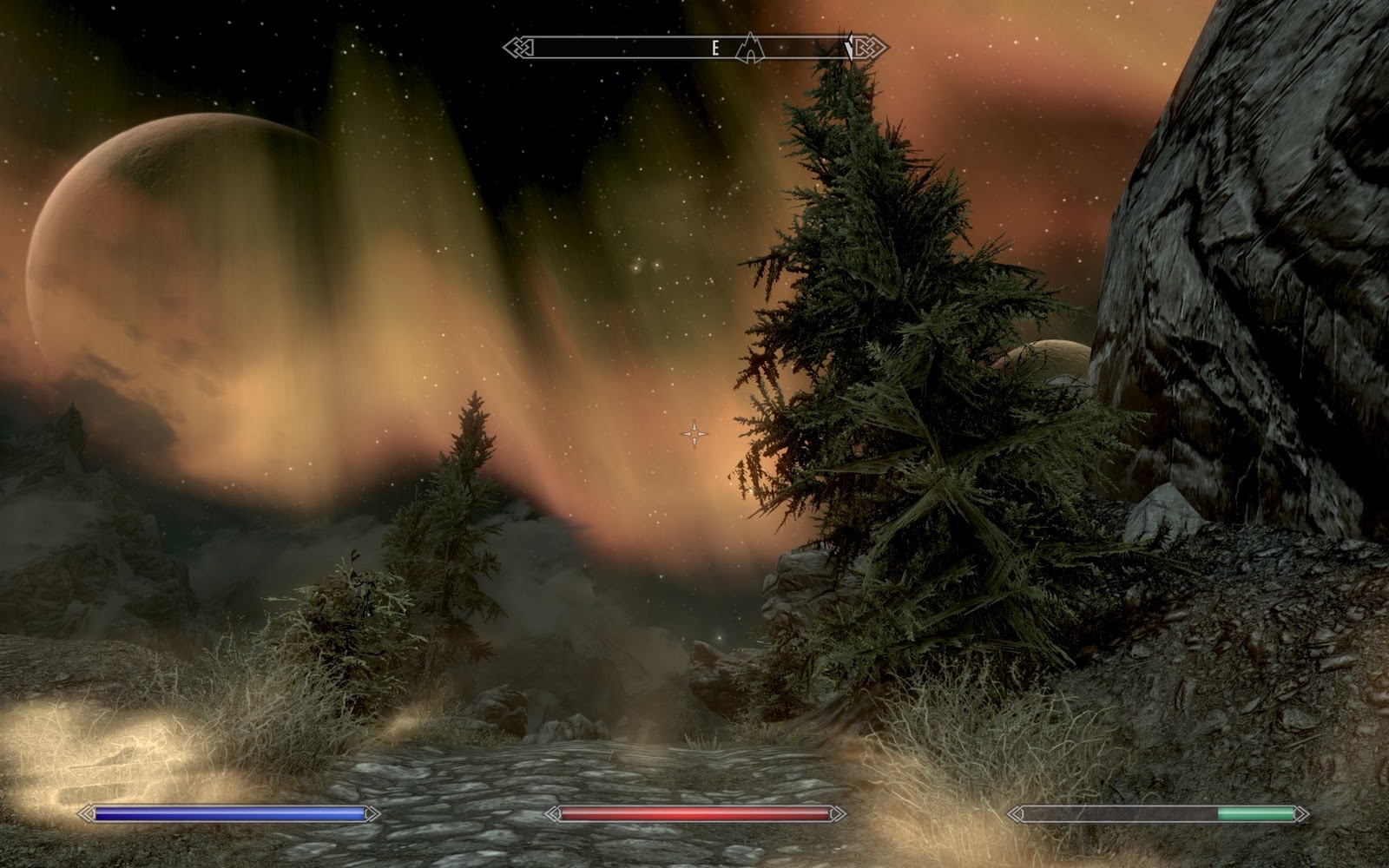
My first steps in this mountain wilderness were purposefully very slow: I had to stop and take a moment to breathe everything in. There was so much artistic detail in front of me that I was absolutely overwhelmed.


Aesthetically, Skyrim is gorgeous. The snowy mountains captivated me, and I was compelled to simply wander the countryside, indulging in my obnoxious habit of picking every alchemical ingredient I could find (sidenote: I'll go into detail about the alchemical system later). After exploring a few paths, I noticed a town off in the distance, and decided to head towards it.
About this time, I decided to pull up my inventory. I hit [Tab], and was presented with this:

I wondered how easy it would be to navigate between each menu, so I played around for a while, and found that navigation is actually relatively fluid.
The item menu has been completely revamped: now, different classes of items with different purposes have been given their own section (i.e. scrolls have a scrolls section), everything is arranged alphabetically, and selection is much easier. On PC, the menus were a bit buggy - clicking, scrolling, and using WASD all interchangeably makes things a little confusing, and sometimes I use the wrong potion, but it's relatively easy to compensate for, and I'm sure it will be patched soon enough.
The magic menu is actually divided conveniently now: individual schools have been given their own tabs. Spells are easy to select, and their effects are defined clearly in the description provided.
Following the main path into town, I was notified: 'You have discovered Riverwood'. The first things I noticed about the village was the huge sawmill operating on river power, and the forge located outside the blacksmith's shop. I was startled when I could actually use the forge myself, and from the blacksmith, I received a few smithing tasks and became more familiar with that particular skill. Being a mage, I quickly became uninterested, and wandered aimlessly about (distracted by a few local chickens) until I found the general store. There, a quest was presented to me immediately: the store had recently been burgled, and the brother and sister running the store were arguing over whether the sister should go out to fight the bandits they suspected had committed the crime. Conveniently enough, I barged in at the end of this argument, and offered to take care of the job for them.
I then turned to the shopkeep to ask if he sold spells, and the new nature of NPC interaction caught me off guard. Rather than zooming in awkwardly on his face, the conversation proceeded naturally, and I was even allowed to look around while I was talking to him. After I asked what he sold, the bartering interface popped up, and I was impressed.
As is clear, the previous method of dividing items has been preserved in trading, which makes item exchange much more convenient. With the new dynamic economy, merchants can actually run out of gold (just like Morrowind!), and will go on cycles of prosperity and near-poverty.
After purchasing my fill of spell tomes and selling the random junk I had collected throughout the tutorial, I decided to venture off into the wilderness and complete the task I'd been assigned by the brother and sister in the general store. Conveniently enough, my quest log had already selected that as my active quest, and I was guided by an arrow on the compass to the barrow in which the item was burgled was supposedly located. The sheer size of the dungeon took me off guard: it actually took about an hour to fully explore (I'm easily distracted), and I found it rather satisfying discovering all of its secrets. The ambient lighting in the dungeon took me off guard as well: just another gorgeous aspect of this game. I found myself using more magic than I ever conceived was possible in an Elder Scrolls game - it actually works now! - and so I'll be reviewing that system in my next blog.
Have fun, good gaming, and remember: don't feed the trolls.
-Toast
My first steps in this mountain wilderness were purposefully very slow: I had to stop and take a moment to breathe everything in. There was so much artistic detail in front of me that I was absolutely overwhelmed.


Aesthetically, Skyrim is gorgeous. The snowy mountains captivated me, and I was compelled to simply wander the countryside, indulging in my obnoxious habit of picking every alchemical ingredient I could find (sidenote: I'll go into detail about the alchemical system later). After exploring a few paths, I noticed a town off in the distance, and decided to head towards it.
About this time, I decided to pull up my inventory. I hit [Tab], and was presented with this:

I wondered how easy it would be to navigate between each menu, so I played around for a while, and found that navigation is actually relatively fluid.
The item menu has been completely revamped: now, different classes of items with different purposes have been given their own section (i.e. scrolls have a scrolls section), everything is arranged alphabetically, and selection is much easier. On PC, the menus were a bit buggy - clicking, scrolling, and using WASD all interchangeably makes things a little confusing, and sometimes I use the wrong potion, but it's relatively easy to compensate for, and I'm sure it will be patched soon enough.
The magic menu is actually divided conveniently now: individual schools have been given their own tabs. Spells are easy to select, and their effects are defined clearly in the description provided.
Following the main path into town, I was notified: 'You have discovered Riverwood'. The first things I noticed about the village was the huge sawmill operating on river power, and the forge located outside the blacksmith's shop. I was startled when I could actually use the forge myself, and from the blacksmith, I received a few smithing tasks and became more familiar with that particular skill. Being a mage, I quickly became uninterested, and wandered aimlessly about (distracted by a few local chickens) until I found the general store. There, a quest was presented to me immediately: the store had recently been burgled, and the brother and sister running the store were arguing over whether the sister should go out to fight the bandits they suspected had committed the crime. Conveniently enough, I barged in at the end of this argument, and offered to take care of the job for them.
I then turned to the shopkeep to ask if he sold spells, and the new nature of NPC interaction caught me off guard. Rather than zooming in awkwardly on his face, the conversation proceeded naturally, and I was even allowed to look around while I was talking to him. After I asked what he sold, the bartering interface popped up, and I was impressed.
 |
| Yes, this character's name is Flub. He's an Orc. ^-^ |
As is clear, the previous method of dividing items has been preserved in trading, which makes item exchange much more convenient. With the new dynamic economy, merchants can actually run out of gold (just like Morrowind!), and will go on cycles of prosperity and near-poverty.
After purchasing my fill of spell tomes and selling the random junk I had collected throughout the tutorial, I decided to venture off into the wilderness and complete the task I'd been assigned by the brother and sister in the general store. Conveniently enough, my quest log had already selected that as my active quest, and I was guided by an arrow on the compass to the barrow in which the item was burgled was supposedly located. The sheer size of the dungeon took me off guard: it actually took about an hour to fully explore (I'm easily distracted), and I found it rather satisfying discovering all of its secrets. The ambient lighting in the dungeon took me off guard as well: just another gorgeous aspect of this game. I found myself using more magic than I ever conceived was possible in an Elder Scrolls game - it actually works now! - and so I'll be reviewing that system in my next blog.
Have fun, good gaming, and remember: don't feed the trolls.
-Toast
Thursday, December 1, 2011
Elder Scrolls Explorer: Skyrim: Intro

I went to my local Gamestop and waited from nine until midnight to finally get Skyrim...I was one of the first 20 out of over 200 to get it at that single outlet.
I dropped my friends off and rushed home, chugged the 32-oz Monster I left in my fridge, and tumbled down the stairs to my gaming rig. The blue light was already glowing in the darkness, and my internet was ready. I inserted the disk, my entirety quivering in anticipation. The installation screen came up...
And said I had to wait nine hours for it to download.
I was beyond furious.
After staring at the progress bar until about 1:45 in the morning, my eyes stopped glowing blood crimson and instead faded to a calmer red. I googled "why the hell isn't skyrim letting me install it pc" and quickly found hundreds of others with problems similar to my own: the Steam servers were glitching, and forced those who purchased the physical copy of Skyrim to download it even though all the data was sitting, raw and ready on the disk. I quickly found the local god in the thread, who posted an easy solution to this problem. Within minutes, I had fixed the issue, installed the game, and began playing.
I have to say: it was well worth all the wait, and all the trouble.
The instant I began my new game, I was blown away by both audial and graphical quality (see screenshots!), when compared to the previous Elder Scrolls installments. On my decent PC rig, people actually looked like people, outlines were smooth, and textures were gorgeous. Varied voice acting was actually present in Skyrim (unlike Morrowind or Oblivion) - over a hundred different actors contributed - and it, coupled with the wonderful visuals I was getting, allowed me to completely immerse myself until 4 in the morning, when I passed out in my chair at my desk.
Within those two hours, however, I discovered many things about this new Elder Scrolls game. I won't spoil the introductory sequence (it's AWESOME), but something I do want to cover in depth is the character creator.
Races in Skyrim Compared to Those in Oblivion
As is plainly visible, characters have changed drastically in many ways. Differences between each race have become more distinct: size and frame tendencies vary more obviously, and all characters are rougher in appearance (fitting, for the land of Skyrim is not a forgiving place). Argonians, Khajit, and Orcs have undergone a complete overhaul, and don't look nearly as silly as they did in Oblivion (Orcs can actually be considered intimidating now!). Also, during race selection, a general overview of each race is provided, along with their origins. There are just as many customization sliders to play around with as in Oblivion (which means there are quite a few), so individual players' characters will never look exactly the same.
After playing around with my Breton's appearance for about twenty minutes, I continued on with the tutorial. I finished it rather quickly, and left well-equipped, which satisfied me immensely (especially when I compared this beginning to Oblivion's, which left you empty-handed and alone in the world q_q ). I took my first steps into the world of Skyrim, and boy, did I love it.
To be continued in the next Elder Scrolls Explorer.
Have fun, good gaming, and remember: don't feed the trolls.
-Toast
Friday, October 28, 2011
Free Download of the Month: League of Legends
It seems as though all free download games are introduced to me by my friends...
Months ago - sometime before summer - my friend Clint dragged me to a game's website. The game was simply known as League of Legends, and he made a million promises about it: that it was an RPG, an MMO, and a TD game, all rolled up into one, and was free to play, too. I brushed his claims off as outrageous, but decided to check it out anyway. I browsed the site for quite a while, finding a couple of rather interesting videos that presented me an epic game where teams of different characters met on a dark battlefield and duked it out using magic, armaments, and brute force. This finally persuaded me to click the download link and play. After I had it up and running, I was presented with an impressively easy-to-understand tutorial, pleasing graphics and dove right in to the streamlined PvP realm, which makes up the main portion of gameplay.
I was rather impressed from the get-go: on a half-decent gaming rig, League of Legends looked...well...great! Even the sign-in page was captivating: a desolate battlefield with a powerful-looking wizard conjuring wisps of blue energy from his hands, and an assassin, poised to strike with blades glowing a menacing green. This took me off guard, as many free-to-play/download games' graphics leave players rather wanting. Even as I began to play the game, the interface and arena of play looked wonderful. Character detail was varied, the color palette was interesting, and the whole of the 3D area didn't have a polygonal feel. It always leaves a warm, fuzzy feeling in my heart when I know that the developers of such a game actually put time and effort into graphical appeal. :D
I figured that before I actually got into the game, I should learn a little bit of its lore and basic strategies, as when Clint was discussing it, he threw so much jargon into every sentence that I was absolutely lost.
The lore behind this game is based around a utopian society where different city-states have come to dominate the political sphere of a fictional world. Rather than wasting time and resources drawing out wars, the city-states instead agreed to form a central combat arena, where they would send their champions to do battle and decide the fate of the realm. You, the Summoner, are an agent of the city-states and control/direct these champions in their battles, connected to them by the Nexus, which sits in the heart of your base. Your objective is to level up your champion, break through the enemy's tower- and champion-based defenses, and destroy their Nexus, thereby winning the match for your team. Of course, this is no small feat, as you have five enemy champions against your team as well, along with the hordes of minions sent as cannon fodder out onto the battlefield from both sides.
After this most basic of research, I found myself thrown into an incredibly intricate arena of play. It would take me an entire blog post to explain its nuances (foreshadowing!), so I'll just go over the basics: in general PvP, two five-person teams, composed of different characters, each with unique skills, are thrown into the arena and attempt to destroy one another's defenses, and eventually their respawn center, the Nexus.
League of Legends insanely fun and disturbingly addicting once you get into it. The graphics are pleasing to the eye, and gameplay is satisfyingly complicated. It's definitely worthy to hold its place as October 2011's Free Download of the Month.
Have fun, good gaming, and remember - don't feed the trolls.
-Toast
Months ago - sometime before summer - my friend Clint dragged me to a game's website. The game was simply known as League of Legends, and he made a million promises about it: that it was an RPG, an MMO, and a TD game, all rolled up into one, and was free to play, too. I brushed his claims off as outrageous, but decided to check it out anyway. I browsed the site for quite a while, finding a couple of rather interesting videos that presented me an epic game where teams of different characters met on a dark battlefield and duked it out using magic, armaments, and brute force. This finally persuaded me to click the download link and play. After I had it up and running, I was presented with an impressively easy-to-understand tutorial, pleasing graphics and dove right in to the streamlined PvP realm, which makes up the main portion of gameplay.
I was rather impressed from the get-go: on a half-decent gaming rig, League of Legends looked...well...great! Even the sign-in page was captivating: a desolate battlefield with a powerful-looking wizard conjuring wisps of blue energy from his hands, and an assassin, poised to strike with blades glowing a menacing green. This took me off guard, as many free-to-play/download games' graphics leave players rather wanting. Even as I began to play the game, the interface and arena of play looked wonderful. Character detail was varied, the color palette was interesting, and the whole of the 3D area didn't have a polygonal feel. It always leaves a warm, fuzzy feeling in my heart when I know that the developers of such a game actually put time and effort into graphical appeal. :D
I figured that before I actually got into the game, I should learn a little bit of its lore and basic strategies, as when Clint was discussing it, he threw so much jargon into every sentence that I was absolutely lost.
The lore behind this game is based around a utopian society where different city-states have come to dominate the political sphere of a fictional world. Rather than wasting time and resources drawing out wars, the city-states instead agreed to form a central combat arena, where they would send their champions to do battle and decide the fate of the realm. You, the Summoner, are an agent of the city-states and control/direct these champions in their battles, connected to them by the Nexus, which sits in the heart of your base. Your objective is to level up your champion, break through the enemy's tower- and champion-based defenses, and destroy their Nexus, thereby winning the match for your team. Of course, this is no small feat, as you have five enemy champions against your team as well, along with the hordes of minions sent as cannon fodder out onto the battlefield from both sides.
After this most basic of research, I found myself thrown into an incredibly intricate arena of play. It would take me an entire blog post to explain its nuances (foreshadowing!), so I'll just go over the basics: in general PvP, two five-person teams, composed of different characters, each with unique skills, are thrown into the arena and attempt to destroy one another's defenses, and eventually their respawn center, the Nexus.
League of Legends insanely fun and disturbingly addicting once you get into it. The graphics are pleasing to the eye, and gameplay is satisfyingly complicated. It's definitely worthy to hold its place as October 2011's Free Download of the Month.
Have fun, good gaming, and remember - don't feed the trolls.
-Toast
Friday, October 21, 2011
I Cast Magic Missile (A DnD Blog): Gameplay 02
Time to finally continue that DnD Gameplay blog that I started oh so long ago!
Before diving into statistic determination, one must have a rudimentary understanding of the dice system used by DnD players. Each die is used in different situations, and DMs as well as adventurers often have their own sets that they use. Sets consist of die that range in number of faces, and each die is referred to by how many faces it has - for example, a 6-sided die would be called a D6. Required for adventurers are the D20, D12, D10, D8, D6, and D4. (DMs generally add one more die to their collection: the D%, which is similar to the D10, except that it counts in tens rather than ones, and is used for determining percentages.) In my guides, I'll be referring to dice with their abbreviated names. Oftentimes, to indicate the number of rolls with a certain die, a number precedes the D. Take, for example, an instruction to roll the D6 four times. To indicate this, I'll write 4D6, just as many DMs (and even other players) will say in gaming sessions.
Once you have your character designed - class, race, and gender decided upon - you MUST record this information where it will be readily available at all times. These three facts play a huge part in how sessions play out. When determining statistics for your character, race and class are the two most important of these data, for they determine a multitude of different things. The first and most vital thing to determine is your Ability Scores. Each race has their own Ability Modifiers, and individual DMs have different ways to determine base Ability Scores. (To provide a generalized explanation, in this blog I'll be using my house rules, which follow DnD rulebooks from series 3.5 relatively closely.) In my sessions, players roll 4D6 and remove the lowest number each time to get their scores (see example below for greater detail). They then can place the scores in any of the 6 Abilities they choose: Strength, Constitution, Intellect, Wisdom, Dexterity, and Charisma. It would be wise to assign high Ability Scores to the Abilities essential to your class, as doing so confers high bonuses to the skills available to you. From here, you must find your Ability Modifiers. Based off of your Ability Score, these numbers are critical, as they will be applied to skills, saving throws (which will be reviewed later), and many other numbers that might just make the difference between life and death. Be sure to record these in their respective areas on your character sheet.
Scores below 10 confer negative bonuses, but as these are relatively rare among adventurers, I'll begin at 10.
10-11: +0
12-13: +1
14-15: +2
16-17: +3
18-19: +4
Example:
For one Ability Score, Godmund the Fighter rolls 4D6, and the die fall in his favor - he gets 2 sixes, a 5, and a 3, which give him one score of 17 after he removes the low 3. He continues his rolls and gets a 12, two 14s, a 15, and an 18. All of these scores are unusually high - the average is 10 - but this is normal for an adventurer. Because Godmund is a Fighter, he must focus largely upon Strength and Constitution - he'll be taking the brunt of the blows from enemies he and his party faces. He places 17 into Strength, and 18 into Constitution. To hit often, he assigns 14 to Dexterity. The adventurer playing Godmund decides to put a twist on his character - he assigns his third highest score of 15 to Charisma, making Godmund more appealing to others so that he can lead his party effectively. To Intellect and Wisdom, he assigns the 10 and the 12, as these abilities are the least relevant to his class.
From here, he determines his Ability Modifiers. Strength gets +3, Constitution +4, Dexterity +2, Intellect +0, Wisdom +1, and Charisma +2.
In the next installment of I Cast Magic Missile, I'll continue my overview of DnD character statistics, covering health, Armor Class, Initiative, Grapple, and other easy-to-determine statistics.
Have fun, good gaming, and remember - don't feed the trolls.
-Toast
Before diving into statistic determination, one must have a rudimentary understanding of the dice system used by DnD players. Each die is used in different situations, and DMs as well as adventurers often have their own sets that they use. Sets consist of die that range in number of faces, and each die is referred to by how many faces it has - for example, a 6-sided die would be called a D6. Required for adventurers are the D20, D12, D10, D8, D6, and D4. (DMs generally add one more die to their collection: the D%, which is similar to the D10, except that it counts in tens rather than ones, and is used for determining percentages.) In my guides, I'll be referring to dice with their abbreviated names. Oftentimes, to indicate the number of rolls with a certain die, a number precedes the D. Take, for example, an instruction to roll the D6 four times. To indicate this, I'll write 4D6, just as many DMs (and even other players) will say in gaming sessions.
Once you have your character designed - class, race, and gender decided upon - you MUST record this information where it will be readily available at all times. These three facts play a huge part in how sessions play out. When determining statistics for your character, race and class are the two most important of these data, for they determine a multitude of different things. The first and most vital thing to determine is your Ability Scores. Each race has their own Ability Modifiers, and individual DMs have different ways to determine base Ability Scores. (To provide a generalized explanation, in this blog I'll be using my house rules, which follow DnD rulebooks from series 3.5 relatively closely.) In my sessions, players roll 4D6 and remove the lowest number each time to get their scores (see example below for greater detail). They then can place the scores in any of the 6 Abilities they choose: Strength, Constitution, Intellect, Wisdom, Dexterity, and Charisma. It would be wise to assign high Ability Scores to the Abilities essential to your class, as doing so confers high bonuses to the skills available to you. From here, you must find your Ability Modifiers. Based off of your Ability Score, these numbers are critical, as they will be applied to skills, saving throws (which will be reviewed later), and many other numbers that might just make the difference between life and death. Be sure to record these in their respective areas on your character sheet.
Scores below 10 confer negative bonuses, but as these are relatively rare among adventurers, I'll begin at 10.
10-11: +0
12-13: +1
14-15: +2
16-17: +3
18-19: +4
Example:
For one Ability Score, Godmund the Fighter rolls 4D6, and the die fall in his favor - he gets 2 sixes, a 5, and a 3, which give him one score of 17 after he removes the low 3. He continues his rolls and gets a 12, two 14s, a 15, and an 18. All of these scores are unusually high - the average is 10 - but this is normal for an adventurer. Because Godmund is a Fighter, he must focus largely upon Strength and Constitution - he'll be taking the brunt of the blows from enemies he and his party faces. He places 17 into Strength, and 18 into Constitution. To hit often, he assigns 14 to Dexterity. The adventurer playing Godmund decides to put a twist on his character - he assigns his third highest score of 15 to Charisma, making Godmund more appealing to others so that he can lead his party effectively. To Intellect and Wisdom, he assigns the 10 and the 12, as these abilities are the least relevant to his class.
From here, he determines his Ability Modifiers. Strength gets +3, Constitution +4, Dexterity +2, Intellect +0, Wisdom +1, and Charisma +2.
In the next installment of I Cast Magic Missile, I'll continue my overview of DnD character statistics, covering health, Armor Class, Initiative, Grapple, and other easy-to-determine statistics.
Have fun, good gaming, and remember - don't feed the trolls.
-Toast
Wednesday, October 19, 2011
Elder Scrolls Explorer: Introduction (Premise)
Another mini-series I'm starting! The Elder Scrolls Explorer is bound to continue on for quite a while
There are thousands of RPGs (Role-Playing Games) out there, of all different sorts. Open world RPGs leave the player to do whatever they want, while guided RPGs bring them along for a ride, giving them goals to reach and bosses to defeat. These two styles are different ends of one spectrum, and there are loads of games in between, each of them unique in what they bring to the table. One specific series has touched me, and helped define what I find to be a good game. The games are known to many by their individual titles: Arena and Daggerfall for the oldschool gamers, and Morrowind and Oblivion for the newbies in the gaming arena. All together, these games make up what is known as the Elder Scrolls Series. They're renowned for their open-ended gameplay and their humungous worlds, and have won many awards, such as Game of the Year, and Best of E3...
I've loved these games ever since I was introduced to them, and I figured that for all of you that haven't yet been introduced, I'd better fill you in. For those of you that have experienced the glory that is an Elder Scrolls game, hang on for the ride, and maybe I'll show you a couple tricks you never knew about beforehand. :D
The premise of the entire series is stated outright in the instruction manuals (that people rarely read, which I have a problem with - but that's for another time): play the way you want to play, and have fun with it! The series always starts the player in a relatively simple tutorial area, whether it be a dungeon or a customs office, where the controls are explained, and the player can design their character any way they like. Character design sets up the general experience for the rest of the game, so quite a bit rests upon it, but if the character doesn't seem to work, it's always possible to work around or fix it (or just design a new character).
After design, the player is sent off with their character into the vast world and left to their own devices. Oftentimes, players choose a mix of exploration and questing, which generally provides the most rewarding gameplay experience. As the world is full of quests for both the most holy and darkest of dark characters, so there's always something new to discover in cities or the wilderness, and dungeons and temples are scattered about as well, offering their loot up to anyone that can face their dangers without being decimated. Combat along journeys can be dealt with in many different ways, and it serves as the main gauge of your character's skill.
The self-guided nature of these games makes playing them feel like leading another life in which decisions at one point can affect hundreds of things in your future...I find it absolutely wonderful, and so do thousands of other gamers. They're definitely worth checking out.
I'll be continuing this series with an actual breakdown of the games, the series history, and the plotline that ties the series together.
Have fun, good gaming, and remember: don't feed the trolls.
-Toast
There are thousands of RPGs (Role-Playing Games) out there, of all different sorts. Open world RPGs leave the player to do whatever they want, while guided RPGs bring them along for a ride, giving them goals to reach and bosses to defeat. These two styles are different ends of one spectrum, and there are loads of games in between, each of them unique in what they bring to the table. One specific series has touched me, and helped define what I find to be a good game. The games are known to many by their individual titles: Arena and Daggerfall for the oldschool gamers, and Morrowind and Oblivion for the newbies in the gaming arena. All together, these games make up what is known as the Elder Scrolls Series. They're renowned for their open-ended gameplay and their humungous worlds, and have won many awards, such as Game of the Year, and Best of E3...
I've loved these games ever since I was introduced to them, and I figured that for all of you that haven't yet been introduced, I'd better fill you in. For those of you that have experienced the glory that is an Elder Scrolls game, hang on for the ride, and maybe I'll show you a couple tricks you never knew about beforehand. :D
The premise of the entire series is stated outright in the instruction manuals (that people rarely read, which I have a problem with - but that's for another time): play the way you want to play, and have fun with it! The series always starts the player in a relatively simple tutorial area, whether it be a dungeon or a customs office, where the controls are explained, and the player can design their character any way they like. Character design sets up the general experience for the rest of the game, so quite a bit rests upon it, but if the character doesn't seem to work, it's always possible to work around or fix it (or just design a new character).
After design, the player is sent off with their character into the vast world and left to their own devices. Oftentimes, players choose a mix of exploration and questing, which generally provides the most rewarding gameplay experience. As the world is full of quests for both the most holy and darkest of dark characters, so there's always something new to discover in cities or the wilderness, and dungeons and temples are scattered about as well, offering their loot up to anyone that can face their dangers without being decimated. Combat along journeys can be dealt with in many different ways, and it serves as the main gauge of your character's skill.
The self-guided nature of these games makes playing them feel like leading another life in which decisions at one point can affect hundreds of things in your future...I find it absolutely wonderful, and so do thousands of other gamers. They're definitely worth checking out.
I'll be continuing this series with an actual breakdown of the games, the series history, and the plotline that ties the series together.
Have fun, good gaming, and remember: don't feed the trolls.
-Toast
Friday, October 14, 2011
Retro Gaming 03: It's-a Me, Mario!
For anyone who grew up around a Nintendo 64 that actually had any decent games, the phrase "It's-a me, Mario!" will hit their nostalgic nerve like a freight train. For those of you that don't know, the Mario series is the iconic series for Nintendo, and the number one hit for its series on the N64 was Super Mario 64 (genius title, I know). Aside from the title, the rest of this game is actually relatively brilliant. It was of decent length, varied gameplay up compared to old Mario games, and kept the player thinking the whole time.
The premise of the game is that Mario has been invited to Peach's castle for cake, but when he arrives, the castle has been taken over by the evil King Koopa, Bowser. He scattered the power source for the castle (and all of the land, the Mushroom Kingdom), known simply as Stars, across different worlds that manifest themselves in paintings throughout the castle. The player then assumes control of Mario and must explore these worlds, gathering stars on each different level and eventually advancing to defeat Bowser - not once, but three times.
Gathering Stars is easy at first - the worlds start off with simple challenges like races, jumping, and defeating easy bosses. Amassing the first 20 Stars and defeating the first iteration of Bowser is obscenely easy. After that, however, things become more challenging: jumps are harder, puzzles more complicated, and situations more dangerous - death is common to the inexperienced player after the first 20 stars. Bowser seems further and further away, as one must collect 70 stars to reach Bowser for the final time (though to truly beat the game, one must collect all 120).
Mario's arsenal of moves had been greatly expanded upon in Super Mario 64. He can perform a number of acrobatic jumps and can even launch off of walls. Mario can also access powerup hats that provide him with different characteristics not otherwise available. There are three different hats: the Wing Cap, Metal Cap, and Invisibility Cap. The Wing Cap allows Mario to take off and fly after successfully performing a Triple Jump - this allows players to fly anywhere they want around the map for the duration the cap stays on Mario's head. The Metal Cap turns Mario into pure sentient steel, making him invulnerable to most kinds of damage and able to sink to the bottom of bodies of water instantly (which proves to be essential many a time). Finally, the Invisibility Cap immaterializes Mario, giving him the ability to pass through certain walls.
Super Mario 64 proved to be an incredibly fun, rather challenging game. Though it had points where it did drag a little, those were made up for by the sense of triumph after completing the puzzle at the end, or getting that final Star in a level. All in all, it's definitely worth a 40 to 50 hour gameplay session.
The premise of the game is that Mario has been invited to Peach's castle for cake, but when he arrives, the castle has been taken over by the evil King Koopa, Bowser. He scattered the power source for the castle (and all of the land, the Mushroom Kingdom), known simply as Stars, across different worlds that manifest themselves in paintings throughout the castle. The player then assumes control of Mario and must explore these worlds, gathering stars on each different level and eventually advancing to defeat Bowser - not once, but three times.
Gathering Stars is easy at first - the worlds start off with simple challenges like races, jumping, and defeating easy bosses. Amassing the first 20 Stars and defeating the first iteration of Bowser is obscenely easy. After that, however, things become more challenging: jumps are harder, puzzles more complicated, and situations more dangerous - death is common to the inexperienced player after the first 20 stars. Bowser seems further and further away, as one must collect 70 stars to reach Bowser for the final time (though to truly beat the game, one must collect all 120).
Mario's arsenal of moves had been greatly expanded upon in Super Mario 64. He can perform a number of acrobatic jumps and can even launch off of walls. Mario can also access powerup hats that provide him with different characteristics not otherwise available. There are three different hats: the Wing Cap, Metal Cap, and Invisibility Cap. The Wing Cap allows Mario to take off and fly after successfully performing a Triple Jump - this allows players to fly anywhere they want around the map for the duration the cap stays on Mario's head. The Metal Cap turns Mario into pure sentient steel, making him invulnerable to most kinds of damage and able to sink to the bottom of bodies of water instantly (which proves to be essential many a time). Finally, the Invisibility Cap immaterializes Mario, giving him the ability to pass through certain walls.
Super Mario 64 proved to be an incredibly fun, rather challenging game. Though it had points where it did drag a little, those were made up for by the sense of triumph after completing the puzzle at the end, or getting that final Star in a level. All in all, it's definitely worth a 40 to 50 hour gameplay session.
Retro Gaming 02, Part 2: A Link to the Past
Continuing my last post, I'll now be diving deeper into the game that is The Legend of Zelda: A Link to the Past.
Uncanny for its time was the sheer vastness of the realm: it takes a few minutes to traverse from one end to the other (unaided), and often about half an hour to hit all the large landmarks in the land. Yet this is only the singular realm of Hyrule - after you battle Agahnim, you are sent to Hyrule's parallel, simply known as the Dark World. The contours and landmarks are essentially the same, but the feel is entirely different: while in Hyrule, you wander a friendly, green landscape, constantly oppressed by the soldiers' omnipresence, in the Dark World you find yourself surrounded by depressing shades of brown, or menacing red and black areas (as well as the occasional white or blue that sticks out like a sore thumb), and are constantly threatened by those that were foolish enough to pursue the Golden Power and are now stuck in their hideous, evil forms.
Gameplay capitalizes on traveling between these two worlds: if the player exploits such transport to the fullest, s/he will find that their heart container (the ingame life meter) is always full, that their equipment is always in top condition, and that treasures await around every corner. The most rewarding part of exploration for many players is the discovery of heart pieces, which are treasures that, when collected in groups of four, increase your heart count (health). These eventually prove essential, as enemies become more deadly and bosses more challenging.
The actual game leads you through the three dungeons in the light realm of Hyrule, and then through the seven temples scattered throughout the Dark Realm. In each dungeon/temple, the formula is relatively simple: find the Big Key (which is usually possible through a little bit of thought-out puzzle solving), get the dungeon's item, and use it to defeat the boss, thereby earning whatever reward (be it pendant or crystallized descendant) afterwords. Though the formula itself is relatively simple, it is made much more entertaining by the fact that there are so many intricate puzzles in each dungeon that one might spend an hour or three in each simply figuring out what's going on, and the satisfaction of finally acquiring that big dungeon item. I remember, just the other day, I was spelunking through a dungeon and dying over and over because of a few obnoxious jellyfish enemies - pathetic, I know, but they're always in the way - until I got the Hookshot. After that, I could fly around wherever I wanted with no fear - the jellies were killed instantly when I shot them. It leads to a small (yet still satisfying) sense of triumph, as the land becomes less and less dangerous as you brave its perils.
All in all, The Legend of Zelda: A Link to the Past is a game definitely worth playing through at least once, if not multiple times, to discover its multitude of secrets and experience the sense of triumph after getting all the items.
Have fun, good gaming, and remember - don't feed the trolls.
-Toast
Uncanny for its time was the sheer vastness of the realm: it takes a few minutes to traverse from one end to the other (unaided), and often about half an hour to hit all the large landmarks in the land. Yet this is only the singular realm of Hyrule - after you battle Agahnim, you are sent to Hyrule's parallel, simply known as the Dark World. The contours and landmarks are essentially the same, but the feel is entirely different: while in Hyrule, you wander a friendly, green landscape, constantly oppressed by the soldiers' omnipresence, in the Dark World you find yourself surrounded by depressing shades of brown, or menacing red and black areas (as well as the occasional white or blue that sticks out like a sore thumb), and are constantly threatened by those that were foolish enough to pursue the Golden Power and are now stuck in their hideous, evil forms.
Gameplay capitalizes on traveling between these two worlds: if the player exploits such transport to the fullest, s/he will find that their heart container (the ingame life meter) is always full, that their equipment is always in top condition, and that treasures await around every corner. The most rewarding part of exploration for many players is the discovery of heart pieces, which are treasures that, when collected in groups of four, increase your heart count (health). These eventually prove essential, as enemies become more deadly and bosses more challenging.
The actual game leads you through the three dungeons in the light realm of Hyrule, and then through the seven temples scattered throughout the Dark Realm. In each dungeon/temple, the formula is relatively simple: find the Big Key (which is usually possible through a little bit of thought-out puzzle solving), get the dungeon's item, and use it to defeat the boss, thereby earning whatever reward (be it pendant or crystallized descendant) afterwords. Though the formula itself is relatively simple, it is made much more entertaining by the fact that there are so many intricate puzzles in each dungeon that one might spend an hour or three in each simply figuring out what's going on, and the satisfaction of finally acquiring that big dungeon item. I remember, just the other day, I was spelunking through a dungeon and dying over and over because of a few obnoxious jellyfish enemies - pathetic, I know, but they're always in the way - until I got the Hookshot. After that, I could fly around wherever I wanted with no fear - the jellies were killed instantly when I shot them. It leads to a small (yet still satisfying) sense of triumph, as the land becomes less and less dangerous as you brave its perils.
All in all, The Legend of Zelda: A Link to the Past is a game definitely worth playing through at least once, if not multiple times, to discover its multitude of secrets and experience the sense of triumph after getting all the items.
Have fun, good gaming, and remember - don't feed the trolls.
-Toast
Wednesday, October 12, 2011
Retro Gaming 02: A Link to the Past
If you take a look at my childhood, about a quarter of it was spent playing one game for the GameBoy Advanced (though I actually played it on an SP). Which game, you might be asking yourself? Well take one look and you'll recognize it from the Legend of Zelda series. It premiered on the Super Nintendo in November 1991, and its name was The Legend of Zelda: A Link to the Past. I was able to spend so much time on this game simply because of its size: it had two full worlds that were completely explorable and absolutely enormous. Gameplay was fun and addicting, and the quest was straightforward, but always a challenge because of the puzzles you faced along the way.
The game begins with an introductory cutscene describing the situation that the realm of Hyrule faces: an evil wizard named Agahnim has killed the king, seized the throne, and is attempting to gain a mysterious "Golden Power" that would make him omnitient. This Power was sealed in a different realm long ago by seven sages, but the wizard is breaking the seal by capturing the sages' descendants and locking them in crystals. You, link, are called out to by the final descendant conscious: Princess Zelda. She summons you to the palace, where Agahnim is about to complete his dark ritual.
At this moment, your uncle (whom you live with) hears the call as well. He was part of the royal guard before the king was murdered, and thusly heads to the castle to save the princess. You leave after he does, braving the storm and avoiding guards, to find him dead in the castle sewers...he gives you his sword and his shield and commands you press on to save the Princess and therefore the world. You're then sent to explore the castle grounds in search of the princess, who's locked away in the dungeon. After a few minutes of wandering and joyfully killing palace guards, you encounter her in her dungeon cell and free her by defeating her flail-wielding guard. You then take her to a sanctuary connected to the palace by a system of poorly lit sewers, leaving her in the hands of the priest there, who then informs you fully about your quest and your duties: you are perhaps the only chance the land has at peace, and the only one in any position to search for the three pendants that unbind the Master Sword from its place in the forest. From there, you're thrown into the massive world that is Hyrule.
Next blog post, I'll be continuing this section of Retro Gaming, diving deeper into the realm of Hyrule.
(Blogging Week 3, Post 1)
Have fun, good gaming, and remember - don't feed the trolls.
The game begins with an introductory cutscene describing the situation that the realm of Hyrule faces: an evil wizard named Agahnim has killed the king, seized the throne, and is attempting to gain a mysterious "Golden Power" that would make him omnitient. This Power was sealed in a different realm long ago by seven sages, but the wizard is breaking the seal by capturing the sages' descendants and locking them in crystals. You, link, are called out to by the final descendant conscious: Princess Zelda. She summons you to the palace, where Agahnim is about to complete his dark ritual.
At this moment, your uncle (whom you live with) hears the call as well. He was part of the royal guard before the king was murdered, and thusly heads to the castle to save the princess. You leave after he does, braving the storm and avoiding guards, to find him dead in the castle sewers...he gives you his sword and his shield and commands you press on to save the Princess and therefore the world. You're then sent to explore the castle grounds in search of the princess, who's locked away in the dungeon. After a few minutes of wandering and joyfully killing palace guards, you encounter her in her dungeon cell and free her by defeating her flail-wielding guard. You then take her to a sanctuary connected to the palace by a system of poorly lit sewers, leaving her in the hands of the priest there, who then informs you fully about your quest and your duties: you are perhaps the only chance the land has at peace, and the only one in any position to search for the three pendants that unbind the Master Sword from its place in the forest. From there, you're thrown into the massive world that is Hyrule.
Next blog post, I'll be continuing this section of Retro Gaming, diving deeper into the realm of Hyrule.
(Blogging Week 3, Post 1)
Have fun, good gaming, and remember - don't feed the trolls.
Subscribe to:
Posts (Atom)